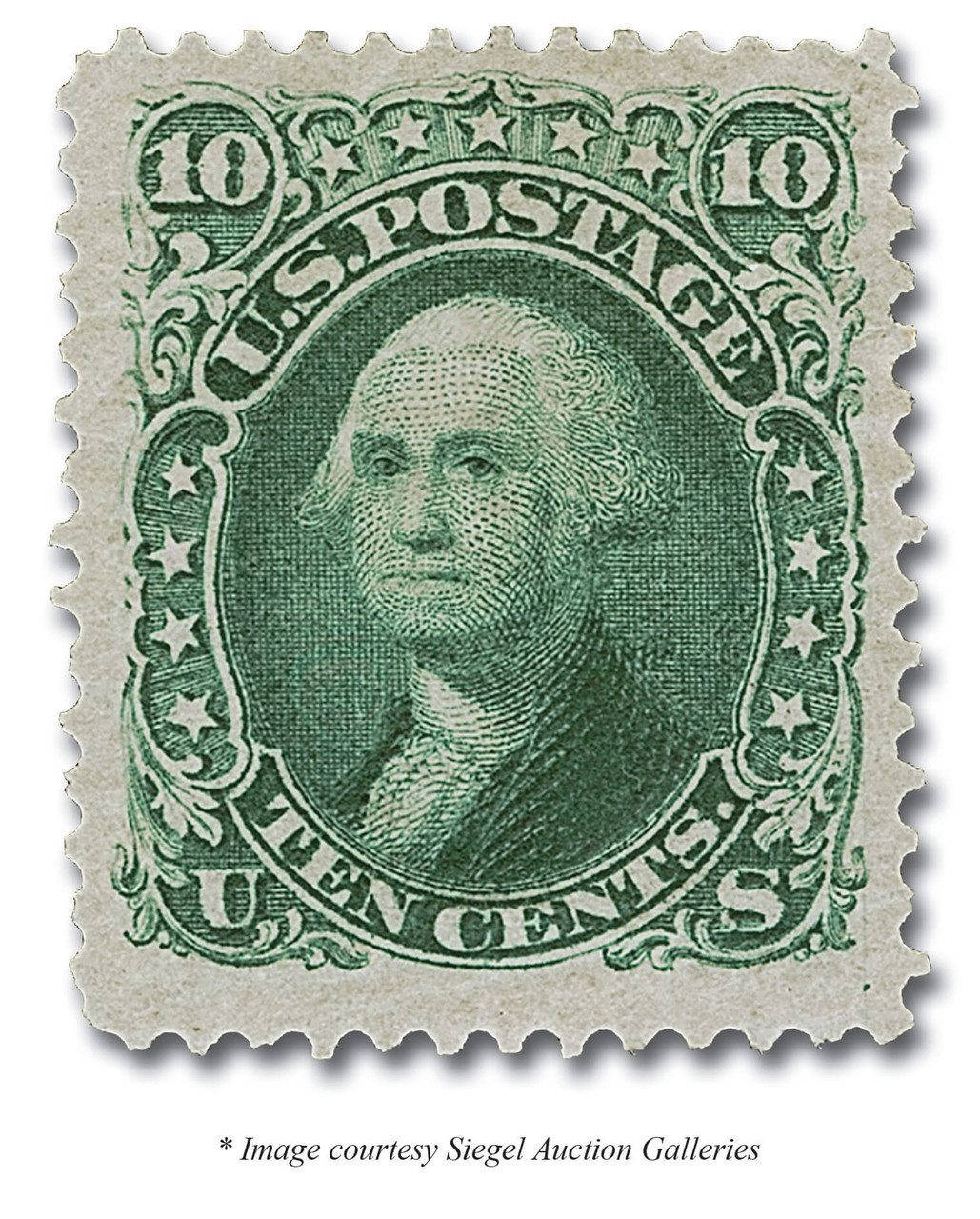
106 – 1875 10c Washington, Green, Perf. 12
$1,600.00
- Estimated Delivery : Up to 15 business days
US #106
1875 10¢ Washington
- Part of the US Post Office’s initiative to re-issue all US postage stamps issued up to that point
- Same design as the 10¢ Washington of 1861-66
Stamp Category: Definitive
Set: Re-Issue of 1861-66 Stamps
Value: 10¢
Quantity Issued: 10,000, but only 451 were sold and most unsold quantities were destroyed
Printed by: National Bank Note Company
Printing Method: Engraved
Perforations: 12
Color: Green
Why the stamp was issued: As part of the US Post Office Department’s reproduction of all US postage stamps for display and sale at the Centennial Exhibition in Philadelphia.
About the stamp design: Pictures the same portrait of George Washington as was pictured on stamp #68.
Special design details: The re-issue can be identified by its lack of grill plus its hard white paper, white crackly gum, and sharper impression.
About the Re-Issue of 1861-66 Stamps: As the nation’s centennial approached, organizers began planning a grand celebration in Philadelphia. It would be the first World’s Fair to be held in the United States. To commemorate the event, the Post Office Department reproduced all US postage stamps for display and sale at the Centennial Exhibition. The reissues were not sold at regular stamp windows, but were made for a Post Office Department display at the 1876 Centennial Exposition. Sets were also sold directly to collectors by the Post Office Department in Washington, DC. The National Bank Note Company produced the reprints in 1875. They are all on hard white paper and feature crackly white gum. Most of these stamps weren’t intended for use as postage and were issued in very small quantities. And most of the unsold stamps were later destroyed, making them extra scarce today!
History the stamp represents: The US Post Office Department wanted to have a strong presence at the Centennial Exhibition. They wanted to sell every US stamp, even those that were no longer in use. Because many of the original plates couldn’t be found, new ones had to be engraved. Observant collectors noticed subtle differences, so Scott gave the re-issues their own numbers. Not realizing they had created philatelic rarities, the Post Office Department sold them as planned.
| Option |
|---|