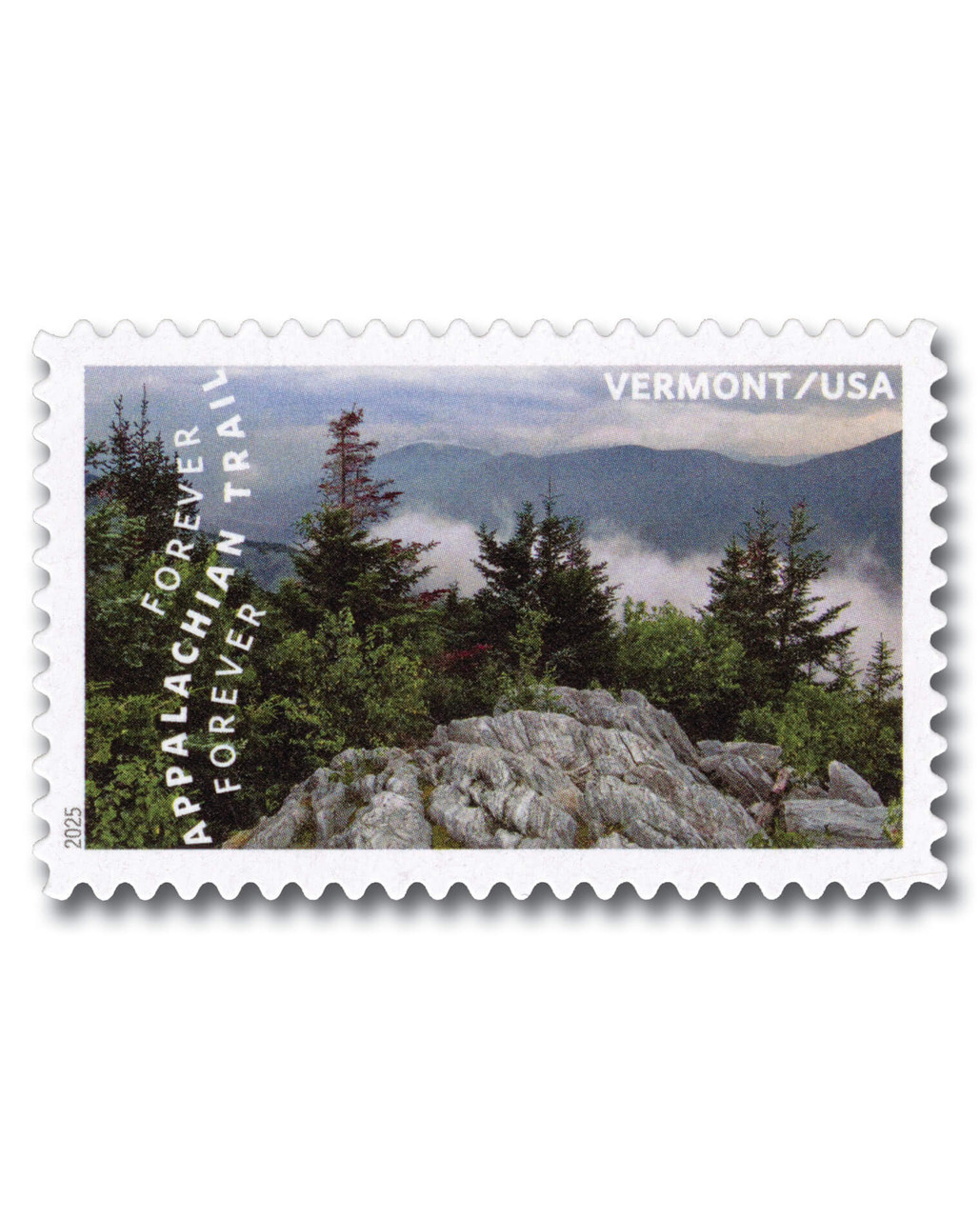
5960f – 2025 First-Class Forever Stamp – Appalachian Trail: Green Mountains, Vermont
$3.00
- Estimated Delivery : Up to 15 business days
US #5960f
2025 Vermont
- Part of pane of 15 stamps highlighting the Appalachian Trail
- Stamps commemorate 100th anniversary of the Appalachian Trail Conservancy
- Feature 15 photos – one from each state the trail passes through plus the “Green Tunnel”
Stamp Category: Commemorative
Set: Appalachian Trail
Value: 73¢; first-class mail rate
First Day of Issue: February 28, 2025
First Day City: Dawsonville, GA
Quantity Issued: 34,500,000
Printed by: Ashton Potter
Printing Method: Offset
Format: Panes of 15
Why the stamps were issued: The set of 15 stamps was issued to bring a bit of natural beauty to our mail as well as mark the 100th anniversary of the Appalachian Trail Conservancy.
About the stamp designs: USPS art director Antionio Alcalá created the Appalachian Trail stamps with existing photographs. Fourteen of the stamps identify the states in which the photos were taken. The other one simply reads “USA,” representing a portion of thick forest known as the “green tunnel.”
Special design details: “Forever” and “Appalachian Trail” climb in a curved shape up the left side of each stamp, resembling the winding 2,197-mile path.
First Day City: The First Day ceremony for the Appalachian Trail stamps was held at Amicalola Falls State Park in Dawsonville, Georgia. This location is close to where the southern portion of the trail ends.
About the Appalachian Trail set: The Appalachian Trail is the world’s longest hiking-only trail. The idea for the trail was introduced in 1921 and it was completed in 1937. Improvements were made over the years, and in 1968, the trail became one of the first National Scenic Trails (along with the Pacific Crest Trail). Today, over three million people hike portions of the Appalachian Trail every year.
The idea for the Appalachian Trail came from Benton MacKaye, a forester who was inspired by Vermont’s iconic Long Trail. It took several years to bring MacKaye’s plan to fruition, with the trail finally being completed in August 1937, although it looked a little different than it does today. Several areas were later connected to the trail.
Since its inception, the Appalachian Trail Conservancy has been the main organization taking care of the trail. However, numerous volunteer hiking clubs and other groups have also helped. Today, the Appalachian Trail is maintained by at least 31 such organizations throughout the 14 states the trail passes through. The work of these volunteers ensures hikers stay safe on the entire 2,197-mile journey from Georgia to Maine.
Many people have completed the Appalachian Trail. The task requires a high level of physical fitness and careful planning as many areas of the trail are difficult even for the most seasoned hiker. However, that doesn’t mean only serious hikers can enjoy the Appalachian Trail. Throughout the span of the trail, there are plenty of day hikes and side paths that allow novice hikers to get a taste of the rugged beauty of the Appalachian Mountains and the eastern United States.
History the stamps represent: Vermont holds a special place in the history of the Appalachian Trail. It is home to the Long Trail, the oldest long-distance trail in the United States. In fact, this trail inspired Benton MacKaye to create the Appalachian Trail.
Today, the Appalachian Trail spans just over 150 miles in Vermont, 100 of which are shared with the Long Trail. The two converge at the Massachusetts border and continue together through southern Vermont, passing the notable peaks of Stratton, Bromley, and Killington. The trails split at “Maine Junction” north of US Route 4, with the Appalachian Trail continuing east for 50 more miles before entering New Hampshire, while the Long Trail heads north.
Vermont isn’t called the Green Mountain State for nothing, offering Appalachian Trail-goers plenty of vibrant scenery. While Killington is the tallest peak since Tennessee for northbound hikers, the Vermont section of trail is a more moderate challenge compared to other states. It gives southbound hikers a bit of a break after the rugged White Mountains of New Hampshire.
All sections of the Appalachian Trail are managed by different volunteers, but Vermont’s Green Mountain Club takes it a step further. They help people from all walks of life experience the state’s beautiful mountains.
| Option |
|---|