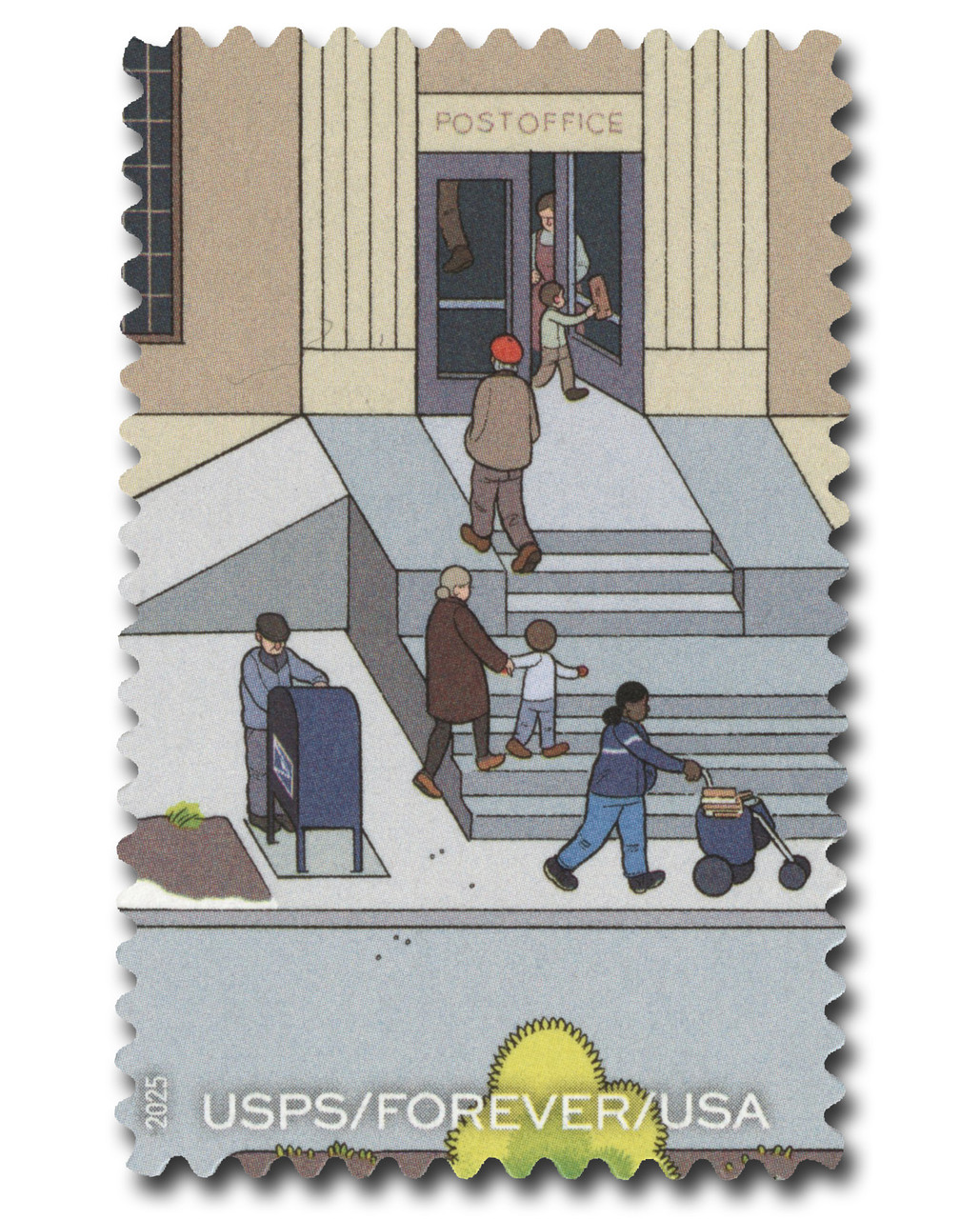
6023b – 2025 First-Class Forever Stamp – 250th Anniversary of Delivering Mail: Postal Worker Walking Past Step
$3.00
- Estimated Delivery : Up to 15 business days
US #6023b
2025 Postal Worker Walking Past Steps
- Part of pane of 20
- Honors 250th anniversary of Post Office
- Highlights routine of postal carrier
Stamp Category: Commemorative
Set: 250 Years of Delivering
Value: Forever First-class mail (78¢)
First Day of Issue: July 23, 2025
First Day City: Washington, DC
Quantity Issued: 1,250,000
Printed by: Ashton Potter (USA) Ltd. (APU)
Printing Method: Offset
Format: Pane of 20
Perforations: Die cut
Why the pane was issued: This stamp is from a pane of 20 issued in honor of the 250th anniversary of the founding of the postal service in the US.
About the stamp design: The pane was illustrated by cartoonist Chris Ware. The stamps connect to form a scene highlighting the presence of the Postal Service throughout the years and the important role it has played in American life over a century and a half. The artwork follows a mail carrier as she walks her daily route through a busy town over the course of the year.
Special design details: Symbols of the postal service are scattered throughout the stamp images. These include mail trucks, collection boxes, and a post rider on horseback.
First Day City: The First Day of Issue for these stamps took place at the US Postal Service headquarters in Washington, DC. The Putting a Stamp on the American Experience prestige booklet was dedicated at the same ceremony.
About the 250 Years of Delivery pane: In 2025, the US Postal Service celebrated a significant milestone: 250 years of connecting the nation. Founded in 1775, when Benjamin Franklin was named the first Postmaster General, the US post office was a fledgling network of post roads. Today, the USPS is one of the most enduring and trusted institutions in American history.
To honor this milestone, this pane of 20 stamps was released, each depicting moments in the life of a modern mail carrier over a year’s time. These stamps tell the story of a community, following the carrier as she braves all seasons delivering letters and packages, while making connections with members of the community. The stamps celebrate the mail carriers who embody the iconic creed, “Neither snow, nor rain, nor heat, nor gloom of night stays these couriers from the swift completion of their appointed rounds.”
The 250th anniversary is a moment to reflect on the remarkable innovations in mail delivery over the years. From the daring days of the Pony Express to the efficiency of railroads, the introduction of airmail in 1918, and the invention of Forever Stamps, the Postal Service has embraced new ideas to better serve the nation. Today, it continues to evolve, using digital tools to streamline logistics and support an increasingly connected world.
More than just delivering mail, the USPS has delivered hope, unity, and progress. Its mission remains timeless: bringing people closer together.
Postal History – Railway Post Offices: Railway Post Office (RPOs) transformed the way mail was processed and delivered in the US, creating a system that combined speed, efficiency, and innovation.
Prior to this service, many complained that mail delivery by horse and stagecoach was too slow. The postmaster general answered these calls by authorizing mail to be put on trains in the early 1830s. For the next 20 years, trains were used to transport mail between post offices. To help speed up service even more, mail clerks began sorting the mail aboard trains between towns in 1864.
To save time, railway post workers developed a way to pick up mail from smaller stations without stopping. With mailbags hung on a crane, postal clerks aboard the train used a metal bar to grab the bag as the train passed.
By 1867, there were 18 railway mail routes that crossed over 4, 435 miles of track. The 160 clerks aboard the trains took pride in their ability to sort up to 600 pieces of mail an hour. Through the mid-1900s, railway mail service dominated the movement of the mail.
The rise of airmail and improved road networks led to the decline of RPOs. In 1977, the last RPO train made its final run, ending an era of innovation that had kept America connected for over a century.
| Option |
|---|