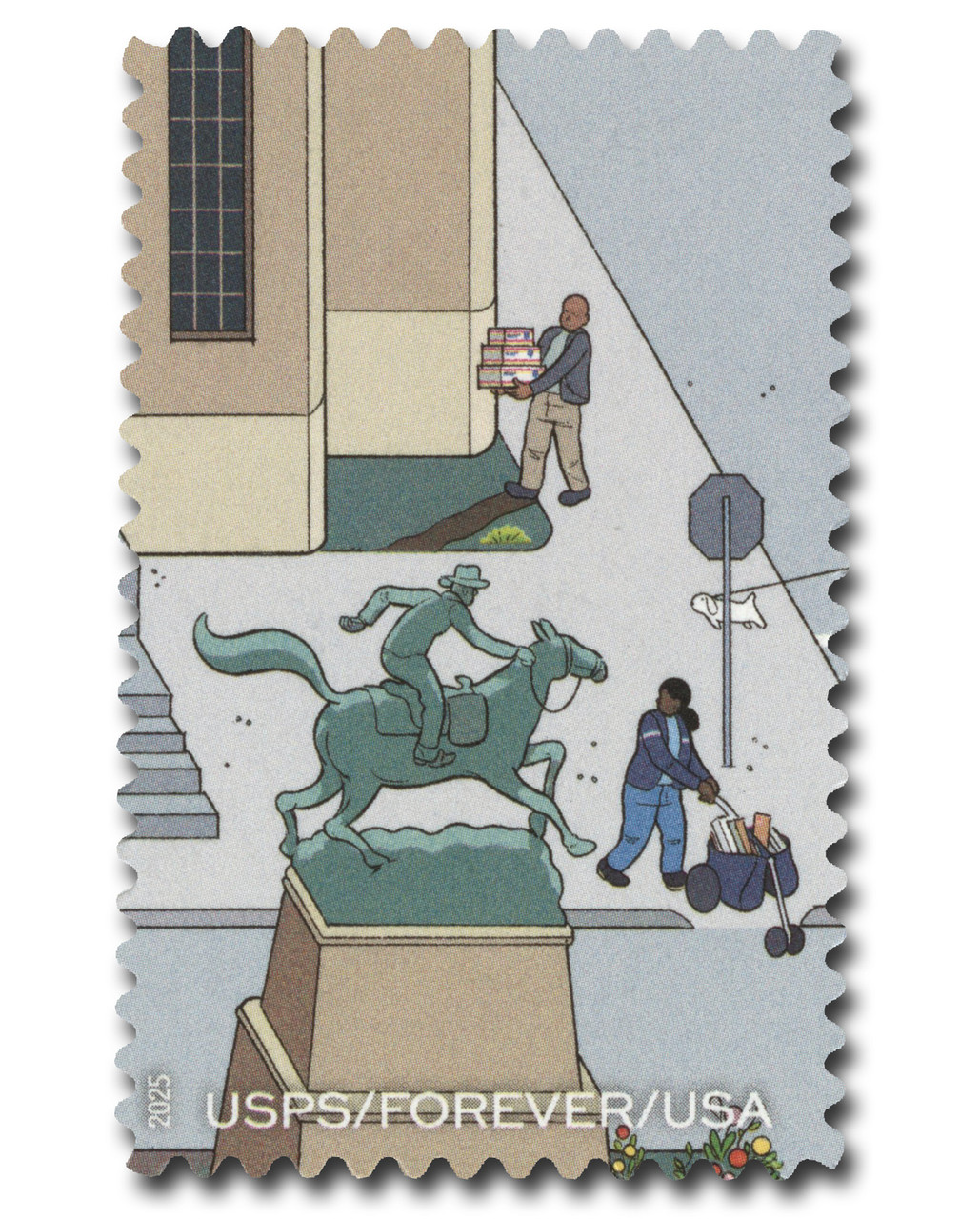
6023c – 2025 First-Class Forever Stamp – 250th Anniversary of Delivering Mail: Pony Express Statue
$3.00
- Estimated Delivery : Up to 15 business days
US #6023c
2025 Pony Express Statue
- Part of pane of 20
- Honors 250th anniversary of Post Office
- Highlights routine of postal carrier
Stamp Category: Commemorative
Set: 250 Years of Delivering
Value: Forever First-class mail (78¢)
First Day of Issue: July 23, 2025
First Day City: Washington, DC
Quantity Issued: 1,250,000
Printed by: Ashton Potter (USA) Ltd. (APU)
Printing Method: Offset
Format: Pane of 20
Perforations: Die cut
Why the pane was issued: This stamp is from a pane of 20 issued in honor of the 250th anniversary of the founding of the postal service in the US.
About the stamp design: The pane was illustrated by cartoonist Chris Ware. The stamps connect to form a scene highlighting the presence of the Postal Service throughout the years and the important role it has played in American life over a century and a half. The artwork follows a mail carrier as she walks her daily route through a busy town over the course of the year.
Special design details: Symbols of the postal service are scattered throughout the stamp images. These include mail trucks, collection boxes, and a post rider on horseback.
First Day City: The First Day of Issue for these stamps took place at the US Postal Service headquarters in Washington, DC. The Putting a Stamp on the American Experience prestige booklet was dedicated at the same ceremony.
About the 250 Years of Delivery pane: In 2025, the US Postal Service celebrated a significant milestone: 250 years of connecting the nation. Founded in 1775, when Benjamin Franklin was named the first Postmaster General, the US post office was a fledgling network of post roads. Today, the USPS is one of the most enduring and trusted institutions in American history.
To honor this milestone, this pane of 20 stamps was released, each depicting moments in the life of a modern mail carrier over a year’s time. These stamps tell the story of a community, following the carrier as she braves all seasons delivering letters and packages, while making connections with members of the community. The stamps celebrate the mail carriers who embody the iconic creed, “Neither snow, nor rain, nor heat, nor gloom of night stays these couriers from the swift completion of their appointed rounds.”
The 250th anniversary is a moment to reflect on the remarkable innovations in mail delivery over the years. From the daring days of the Pony Express to the efficiency of railroads, the introduction of airmail in 1918, and the invention of Forever Stamps, the Postal Service has embraced new ideas to better serve the nation. Today, it continues to evolve, using digital tools to streamline logistics and support an increasingly connected world.
More than just delivering mail, the USPS has delivered hope, unity, and progress. Its mission remains timeless: bringing people closer together.
Postal History – Pony Express:
In 1860, William Russell, Alexander Majors, and William B. Waddell sought to create a mail-carrying company that would be faster and more efficient than the stagecoaches of the Butterfield Overland Mail. At that time, it could take months for mail to be delivered to the unsettled West by stagecoach.
In just two months, they established 184 stations 10-15 miles apart. The three founders then put a call out for small, brave young men that could ride a horse well. They purchased 400 of the fastest horse they could find and hired 80 daring riders. The first ride left St. Joseph, Missouri, on April 3, 1860, and arrived in Sacramento, California, just ten days later. In the mochilla, or saddlebag, was a message of congratulations from President Buchanan to the governor of California, which had been telegraphed from Washington to St. Joseph.
The rides were dangerous, but the pay was good – $25 a week, or the equivalent of over $5,800 in wages today. The Pony Express riders, mostly men younger than 18 years old, were expected to cover 75 miles without rest, despite inclement weather and Native American attacks. Picking up a rested horse at each station, they rode non-stop, day and night, rain or shine.
Buffalo Bill Cody, who became famous for his Wild West Show, claimed he rode for the Pony Express when he was just 15 years old. His route was through Wyoming, and he told of one time when he rode 322 miles round trip because his relief rider had been killed in a brawl.
The route could be completed in eight days, which was 12 to 14 days faster than the Overland Mail. The fastest trip was seven days when riders delivered the news of Abraham Lincoln’s presidential election in November of that year. With extra riders and horses in place, the news traveled from Fort Kearny, Nebraska, where the eastern telegraph line ended, to the start of the western line at Fort Churchill, Nevada Territory. Newspapers in California were able to report Lincoln’s victory in an unprecedented eight days after the election.
Initially, it cost $5 to send a letter between San Francisco and St. Joseph, Missouri, but that charge was later reduced to $1. An estimated 35,000 letters were carried by the Pony Express.
This adventurous service came to an end just 18 months after that first ride. On October 24, 1861, the Western Union Telegraph Company completed the first transcontinental telegraph line in Salt Lake City. This accomplishment ushered in a new age of communications in the US and marked the end of the Pony Express two days later, on October 26. In spite of its fame, the Pony Express was a financial failure.
In 1862, Wells, Fargo & Company established its own Pony Express, dubbed the “Virginia City Pony.” This service traveled between mining towns in Nevada and the California business centers of Sacramento and San Francisco. While the original Pony Express delivered news, the Virginia City Pony was more concerned with business matters. Improvements in the roads allowed for faster transportation, and the Virginia City Pony was discontinued in 1865.
| Option |
|---|