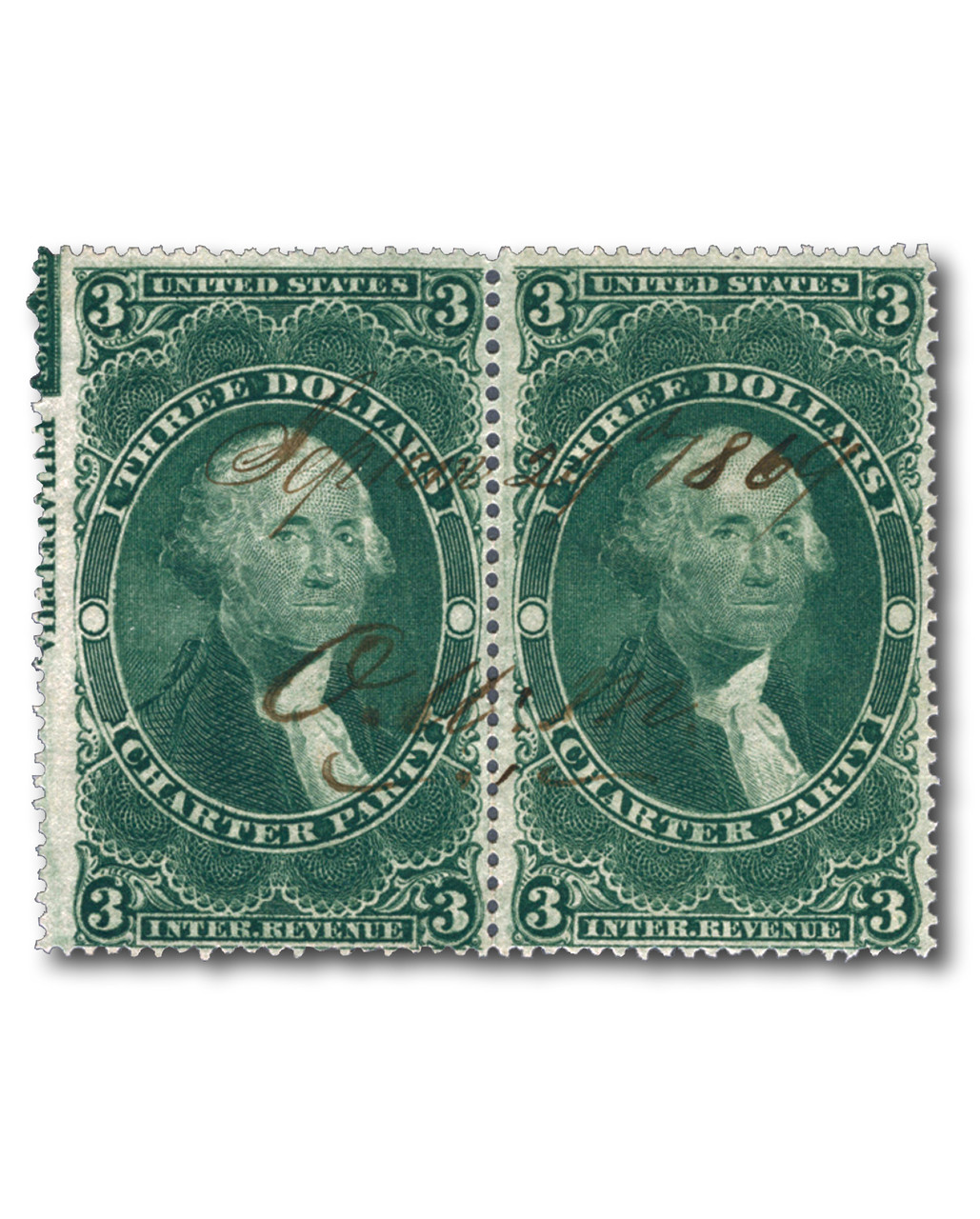
MRS1002 – 1862 $3 Green Washington First Issue Revenue Imprint Pair (Scott #R85c)
$500.00
- Estimated Delivery : Up to 15 business days
First Issue Revenue Stamp Features Printer’s Imprint
The 1862 $3 Green Washington First Issue Revenue Imprint Pair (Scott #R85c) is a perforated pair of revenue stamps featuring an imprint from Butler & Carpenter of Philadelphia in the margin of the stamp on the left. An imprint refers to the name of the printer inscribed on the stamps or in the sheet margins. These particular stamps were issued for use on a “Charter Party” agreement or contract. It would have been used on a contract for the charter of a ship, or any correspondence between the captain or owner of a ship concerning the freight or conveyance of money, goods, or effects aboard the vessel.
The Revenue Act Of 1862 and The Revenue Stamps Resulting From It
On July 1, 1862, President Abraham Lincoln signed the Revenue Act of 1862 into law, to help fund the Civil War. The Act created a tax on virtually every document along with proprietary items including matches, perfume, and medicine. To show tax payment, the first adhesive US Revenue stamps were planned. The stamps were intended to be perforated; however, time was of the essence. To speed the process, the printing company was allowed to ship the early stamps without perforations or with partial perforations.
George Boutwell, the first Commissioner of Internal Revenue, approved the early Revenue stamp designs and accepted Butler and Carpenter’s bid on August 8 to print the stamps. That meant they had less than two months to produce the stamps before the law went into effect on October 1, 1862. They submitted the first two plates to Boutwell on September 3, 1862.
Initially, each taxable item required a specific Revenue stamp, leading to 94 separate stamps issued by the end of 1862. The purchaser of the stamp was required to cancel the stamp by writing the date and initializing the stamp. Failure to use a stamp was punishable by a $50 fine and having the document declared invalid.
The specific stamp requirement was dropped on Christmas Day, 1862. After that date, the stamps could be used interchangeably with the exception of proprietary items, which continued to require their own specific stamps.
The Civil War ended in 1865. States that had seceded and joined the Confederate States of America were now subject to the same federal tax laws as those that had not. Until the use of Revenue stamps was abolished in 1883, money raised through the tax was used to pay down the accumulated Civil War debt. Revenue stamps were brought back into use in 1898 to help fund the Spanish-American War. They were then used off and on until the 1960s for a variety of purposes.
| Option |
|---|